How to Choose Medical Disposable Nonwoven Products
Choosing Medical Disposable Nonwoven products is a performance decision, not a price comparison alone. A gown, mask, drape, and wound dressing face different fluids, stresses, and wear times. The material that works well in one setting may fail in another.
Market reports show why careful evaluation matters. Grand View Research estimated the global nonwoven fabrics market at USD 53.6 billion in 2023 and projected continued growth through 2030. That figure covers many uses, not medical disposables alone. Smithers’ nonwovens market reports also track demand by process and application, helping buyers understand a changing supply landscape. Market growth, however, does not prove that a product suits a specific clinical task.
Consider the details you can inspect: fiber type, fabric weight, barrier performance, breathability, seam strength, and lint release. Ask suppliers for technical data and test results relevant to the intended use. Then check whether those results match your own requirements. Small details matter.
Professor Behnam Pourdeyhimi, a leading nonwovens researcher, has emphasized engineering materials for their end use. A practical paraphrase of that principle is: “Match the structure to the task.” That is not a substitute for product testing. No single fabric fits every setting.
This guide explains how to compare disposable nonwoven products with evidence, application needs, and handling conditions in view. Some specifications may look convincing on paper. Verify them before choosing.
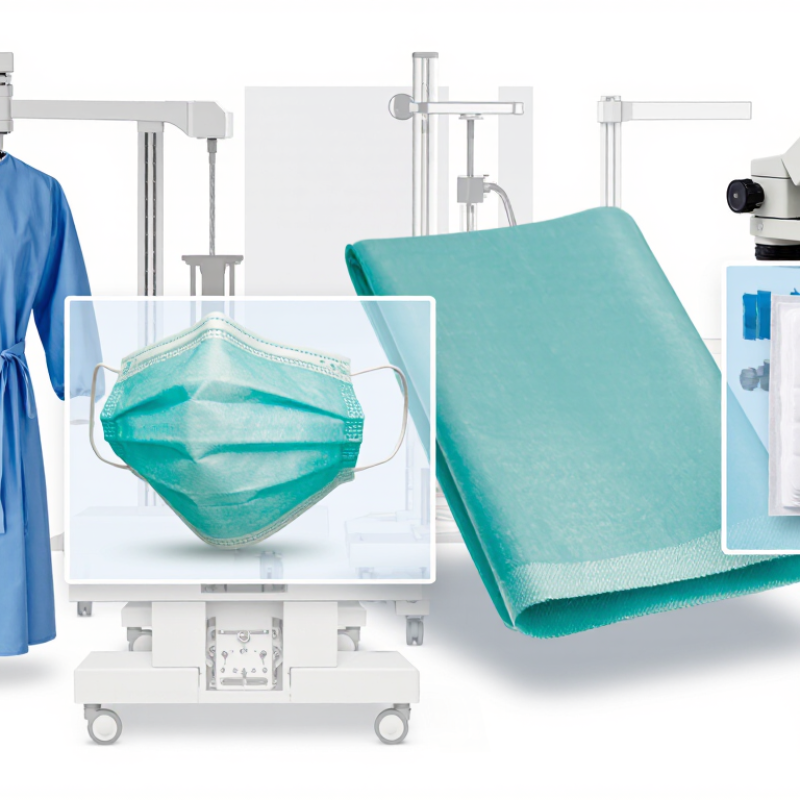
Define the Intended Medical Use and Level of Protection
Choose disposable nonwoven products by exposure, task duration, and likely fluid contact. A procedure involving dry handling may need breathable coveralls, while wound care or surgery can require gowns with tested liquid barriers. Face masks, caps, and drapes protect different sites; one product cannot replace another. Define the hazard clearly. Then match the barrier to it.
Use recognized test results, not vague terms such as “medical grade.” ASTM F2100-23 sets performance benchmarks for medical face masks: its Level 1 requires at least 95% bacterial and particle filtration, while Levels 2 and 3 require at least 98%. Synthetic blood resistance rises from 80 mmHg at Level 1 to 120 and 160 mmHg at Levels 2 and 3. For gowns, AAMI PB70 classifies liquid-barrier performance across four levels. These figures describe specific laboratory tests, not guaranteed protection in every clinical situation. Fit, seams, wear time, and correct removal still matter.
Tips: Check the product’s intended-use statement and test documentation. Match the protection level to the task, then consider heat and mobility. A higher barrier can feel less comfortable. That trade-off deserves a real-world trial with staff, not guesswork.
Compare Nonwoven Materials and Their Functional Properties
Medical disposable nonwovens differ in softness, strength, absorbency, and barrier performance. Spunbond polypropylene is lightweight and often used for gowns, caps, and shoe covers. Its continuous fibers help resist tearing, but the fabric absorbs little moisture. That matters during longer procedures.
SMS combines spunbond layers with a fine meltblown center. The outer layers add strength; the middle layer can improve resistance to fluid penetration. It may feel less breathable than a lighter single-layer fabric. No material is perfect. Viscose or viscose-polyester blends can feel softer and absorb moisture better, which may suit wipes or absorbent layers. Yet softness alone does not indicate reliable barrier performance.
Match the material to the task. For fluid exposure, check test results for penetration resistance, not just a fabric description. For extended wear, consider air permeability, drape, seam construction, and how the garment fits when reaching or bending. A sample should be checked under realistic handling conditions: stretched at the cuff, rubbed against a surface, or exposed to moisture. Small differences matter. Claims can vary by product weight, layer arrangement, and manufacturing quality, so compare specifications for the finished item rather than assuming all nonwovens behave alike.
Check Compliance, Sterility, and Product Safety Requirements
Choosing medical disposable nonwoven products starts with their intended use. A surgical gown, examination drape, and patient mask face different risks. Check the product’s stated purpose, user instructions, and performance claims. Requirements vary by market and use, so confirm which standards and registrations apply before purchasing. Ask for current conformity documents, test reports, and clear labeling. Paperwork matters.
Sterility must be explicit. If a product is supplied sterile, review the sterilization validation, packaging integrity, expiry date, and storage conditions. A wet, torn, or opened pouch may compromise the sterile barrier. Check lot identification so products can be traced if a quality issue arises. If the item is nonsterile, ensure its labeling says so and that it suits the intended procedure. Do not assume that “clean” means sterile.
Product safety also depends on contact type and duration. Review material composition, skin-contact or biocompatibility evidence where relevant, and test data supporting claims such as fluid resistance or low linting. A specification sheet should match the exact model being supplied, not merely a similar fabric. Ask how changes in materials or manufacturing are controlled. One detail is easy to miss: storage heat or humidity can affect packaging. Check the supplier’s instructions, and document any unresolved questions before approval.
Assess Fit, Comfort, and Ease of Use
Choosing medical disposable nonwoven products means checking how they fit during real tasks, not just on a package diagram. A gown should cover the torso and wrists when a worker reaches forward; a mask should sit securely without pulling painfully behind the ears. Loose edges can catch on equipment. Tight seams can restrict movement. Neither problem is obvious during a quick inspection. NIOSH’s Anthropometric Survey of U.S. Healthcare Workers measured head and face dimensions in 3,997 workers, documenting the variation that a single “standard” fit may overlook.
Comfort affects whether a product stays in place through a full shift. Check the softness against skin, breathability, cuff tension, and how easily gloves can be pulled over sleeves. For masks and respirators, assess fit on the intended wearer; appearance alone cannot confirm a seal. CDC/NIOSH guidance calls for fit testing of tight-fitting respirators before use and at least annually. That is a practical reminder: product selection and wearer fit are separate checks. We sometimes treat comfort as subjective, but repeated pressure marks or fogged eyewear are useful feedback.
Tips: Try samples during ordinary movements: bend, reach, and turn your head. Note slipping, heat buildup, and snagging. Ask several wearers, not just one. A small trial may expose an awkward seam—or miss one. Recheck after changing sizes, layers, or task routines.
How to Choose Medical Disposable Nonwoven Products - Assess Fit, Comfort, and Ease of Use
| Product type | Fit and coverage to assess | Comfort considerations | Ease-of-use considerations | Selection checks |
|---|---|---|---|---|
| Medical face mask | Check that the mask covers the nose, mouth, and chin, and that the nose area and side edges sit securely on the wearer’s face. | Assess ear-loop or tie comfort, nose-piece pressure, breathability, and whether the mask stays in place during expected wear. | Consider how easily it can be put on and removed, how securely ties or loops hold, and whether the wearer can identify the correct orientation. | Match the mask to the intended clinical task and applicable requirements. A face mask is not a substitute for a respirator when respiratory protection is required. |
| Disposable isolation gown | Check coverage of the torso and arms, sleeve length, closure position, and whether the gown overlaps adequately at the back for the wearer and task. | Consider freedom of movement at the shoulders and arms, fabric feel, heat buildup, and whether cuffs work comfortably with gloves. | Check that the gown can be tied or fastened without assistance when appropriate, and that it can be removed without unnecessary contact with the outer surface. | Select the gown’s protection level and construction according to the anticipated exposure and applicable standards or facility protocol. |
| Disposable coverall | Check the size range and room for bending, reaching, and layering. Assess hood, ankle, wrist, and closure fit as applicable. | Consider ease of movement, heat retention, fabric stiffness, and compatibility with other required protective equipment. | Review the donning and removal sequence, closure design, and whether the wearer can use the garment safely without damaging it. | Choose construction and protection claims for the specific hazard and task; a general nonwoven coverall does not provide the same protection as every specialized protective garment. |
| Disposable bouffant cap | Check that the cap contains the hair required by workplace policy without slipping or creating excessive pressure around the head. | Assess elastic comfort, breathability, and whether the cap remains comfortable for the expected wear period. | Consider how quickly it can be opened and donned, and whether the elastic edge stays in position during routine movement. | Confirm that the size and coverage suit the wearer and the hygiene requirements of the work area. |
| Disposable shoe covers | Check that the cover fits over the intended footwear and stays in place without restricting walking or catching on the shoe. | Assess pressure from the elastic opening and whether the material feels suitable for the expected duration of use. | Look for a clear, simple donning method and consider whether covers can be removed while minimizing contact with the contaminated exterior. | Check the sole design and any stated slip-resistance or fluid-resistance claims against the actual floor conditions and task. |
| Disposable nonwoven drape | Confirm that its dimensions and shape cover the required area and allow suitable placement around the procedure site. | Consider flexibility, drapeability, and whether the material stays positioned without obstructing the working area. | Assess how easily the drape unfolds, can be positioned, and can be handled during the procedure. | Verify the intended use, sterile status when required, and product specifications for the procedure and facility protocol. |
Selection note: Fit and comfort vary by wearer, product design, and task. Review the product’s labeling and instructions for use, confirm applicable regulatory and facility requirements, and evaluate representative samples before routine purchasing.
Evaluate Packaging, Shelf Life, and Supplier Reliability
Packaging deserves more attention than its appearance. Check that each pouch or carton is intact, dry, and clearly labeled. For sterile products, inspect the sealed barrier for punctures, open edges, or moisture. For nonsterile items, confirm the packaging keeps products clean during storage and handling. Small details matter. A crushed corner may be harmless, but it deserves a closer look.
Shelf life varies by product and packaging, so use the date and storage instructions provided by the manufacturer. Do not assume that all nonwoven products have the same usable period. Keep cartons away from heat, sunlight, and damp floors, and rotate stock by expiry date. A date alone is not enough. If a package is damaged or its storage history is unclear, set it aside and seek guidance rather than guessing.
Supplier reliability shows in consistent records and clear communication. Ask for lot traceability, current product specifications, and notice of material or packaging changes. During receiving checks, compare labels with the order and record any mismatch. A polished document can still leave practical questions unanswered, so test the supplier’s response before a shortage makes the decision urgent. No supplier is perfect; timely, transparent corrections are a useful sign of dependable service.
English
Français 