What Is a Bridge Crane and How Does It Work?
A Bridge Crane is a powered lifting system designed to move heavy loads across a defined workspace. It usually includes parallel runway beams, a traveling bridge, a trolley, and a hoist. Picture a steel beam crossing a factory bay, with a suspended hook moving over machines, pallets, or assembly stations. The bridge travels lengthwise. The trolley moves sideways. The hoist raises and lowers the load. This coordinated movement creates controlled coverage across large floor areas.
Industry reports show why this equipment remains important. Fortune Business Insights’ Overhead Cranes Market report identifies manufacturing, construction, and logistics as major demand sectors. Grand View Research also reports continued growth in overhead material-handling equipment, supported by warehouse expansion and industrial automation. Exact market estimates vary between publishers. That difference deserves attention. Market definitions often combine bridge cranes with gantry, monorail, and other overhead systems.
A reliable explanation must cover more than lifting capacity. It should address rated load, span, duty class, travel speed, controls, and structural support. CMAA Specification No. 70 provides widely used guidance for top-running multiple-girder cranes. In the United States, OSHA 29 CFR 1910.179 addresses overhead and gantry crane safety requirements. Operators must also consider load balance, hook condition, runway alignment, and visible damage before use. Small details matter. A swinging one-ton load can expose weak planning immediately. This article explains what a Bridge Crane is, how its mechanisms work, and where practical design decisions can prevent costly mistakes. No single configuration fits every facility. That is the point worth remembering.
Bridge Crane Definition: Components Governed by ASME B30.2
What Is a Bridge Crane and How Does It Work?
A bridge crane moves loads across a workspace using parallel runways and a traveling bridge. The bridge supports a trolley and hoist. The trolley moves sideways, while the hoist raises or lowers the load. This simple movement becomes highly controlled through coordinated mechanical and electrical components.
ASME B30.2 governs top-running overhead and gantry cranes. Its requirements address construction, inspection, operation, maintenance, and safety practices. Key components include end trucks, bridge girders, runway rails, trolley frames, hoists, brakes, hooks, controls, and limit devices. Each part has a practical purpose. Brakes stop motion. Limit devices help prevent overtravel. The hook connects the lifting system to a properly balanced load.
A practical inspection often reveals more than a drawing. Rail alignment may be slightly uneven. A pendant control may hang at an awkward height. Small defects can affect safe operation. Operators should check controls, hooks, wire rope, brakes, and warning devices before use. Maintenance personnel should document findings and follow the crane manufacturer’s instructions, applicable workplace rules, and the current ASME B30.2 edition. The standard does not replace site-specific risk assessment. It also does not make careless loading acceptable. Load weight, center of gravity, clearance, and surrounding traffic still matter. Good design reduces risk, but human judgment remains essential. Mistakes happen. Careful inspection catches some of them.
Bridge Crane Types: CMAA Classes A–F and Typical 1–100 t Capacities
What Is a Bridge Crane and How Does It Work?
A bridge crane moves loads across a building using parallel runway beams. Its bridge travels along end trucks, while a trolley crosses the bridge. A hoist then lifts or lowers the load with controlled vertical motion. Operators may use a pendant station or remote control. In a busy fabrication shop, a 10-ton crane can move steel plates from storage to a welding bay within minutes.
Bridge crane selection often follows CMAA Classes A–F. Class A suits infrequent, precise lifting, such as maintenance work. Class B handles light service, including occasional tool or equipment movement. Class C supports moderate production, often with several lifts per hour. Class D is designed for heavier production and repeated loading. Class E serves severe-duty operations, such as scrap handling or demanding process work. Class F supports continuous, highly intensive service and requires careful engineering. Typical bridge crane capacities range from 1 to 100 tonnes, but capacity alone does not define suitability. Span, lift height, duty cycles, load distribution, and building structure matter too.
Tips: Record the heaviest load, lifting frequency, travel distance, and daily operating hours before choosing a class. Inspect hooks, ropes, brakes, controls, and runway connections regularly. Keep loads centered and avoid side pulling. A tidy specification can still miss real working conditions. That deserves a second review. Clearance is easy to underestimate, especially near roof beams, lights, and sprinkler lines. Direct measurements and documented inspections make the final decision more dependable.
How Runways, Bridges, Trolleys, and Hoists Produce Three-Axis Motion
What Is a Bridge Crane and How Does It Work?
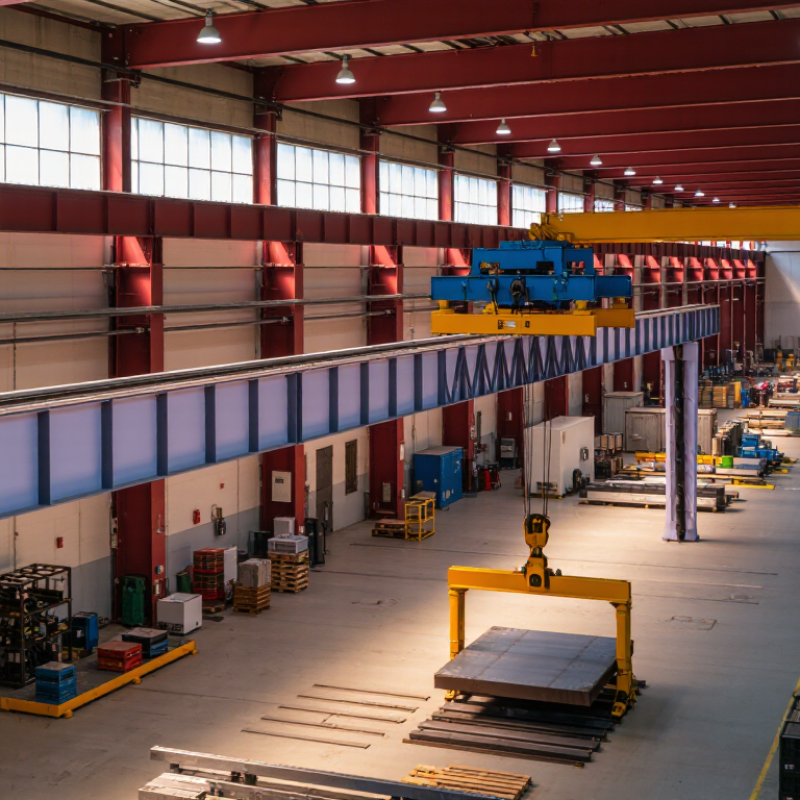
A bridge crane creates three-axis motion through four coordinated parts. Runways are fixed parallel beams along the building. End trucks move the bridge lengthwise, creating the first axis. The bridge spans the runways. Its trolley travels across the bridge, creating the second axis. Finally, the hoist lifts or lowers the load, providing vertical movement. Together, these motions place steel coils, machinery, or containers within a defined work zone. The operator usually controls speed, direction, braking, and lifting from a pendant, cabin, or remote device.
A 2024 industry market report estimated the global overhead-crane market at roughly US$4.5 billion. That scale reflects continued demand in manufacturing, construction, and logistics. Yet market growth does not guarantee safe operation. OSHA rules require visible rated-load markings and regular inspections for overhead cranes. In practice, a drawing may show perfect alignment, while a real floor has uneven loading, blind corners, and swinging hooks. That gap deserves attention. A small trolley movement can amplify load sway, especially with long or flexible loads.
Tips: Check runway alignment before commissioning. Test travel limits without a load. Inspect wire rope, hooks, brakes, and pendant controls before each shift. Keep the load centered under the hoist. Never use diagonal pulling to “save time.” It can stress the bridge and destabilize the load. Maintenance records should note defects, corrective actions, and inspection dates. A missed entry may seem minor, but it weakens traceability when conditions change.
What Is a Bridge Crane and How Does It Work?
A bridge crane produces three-axis motion through the runway, bridge, trolley, and hoist. The chart shows representative operating-speed ranges commonly used for industrial overhead bridge cranes.
Runway travel moves the bridge along the building, trolley travel moves the hoist across the bridge, and hoisting raises or lowers the load. Actual speeds vary according to load capacity, lift height, duty class, and engineering requirements.
The Lift Cycle: Traveling, Hoisting, Positioning, and Lowering Loads
What Is a Bridge Crane and How Does It Work?
The Lift Cycle: Traveling, Hoisting, Positioning, and Lowering Loads
A bridge crane moves heavy loads across a building using parallel runways and a traveling bridge. A trolley moves along the bridge, while a hoist raises or lowers the load. The operator controls these movements from a pendant, cabin, or remote station. Each movement needs clear communication and careful observation.
The lift cycle begins with traveling. The bridge moves along the runway toward the pickup area. The trolley then aligns the hoist above the load. Small alignment errors can create dangerous side pulls. The hoist raises the load slowly, keeping chains or wire ropes vertical. The operator watches for swinging, twisting, and unusual noise.
Positioning requires steady travel and controlled speed. The load may sway when the crane stops suddenly. Experienced operators use smooth acceleration and short corrections. The cycle is rarely perfectly smooth. That deserves attention. Before lowering, the operator checks the landing surface and confirms that workers are clear. The load descends gradually until it rests firmly. The lifting gear should then become slack before anyone disconnects it.
Practical reliability depends on inspections, accurate load information, and trained personnel. Operators should check brakes, hooks, controls, and visible damage before use. They should also stop when visibility is poor or the load behaves unexpectedly. A rushed lift saves little time and can hide a serious mistake.
Safety Metrics: OSHA 1910.179, Rated Load, Inspections, and Duty Cycles
What Is a Bridge Crane and How Does It Work?
A bridge crane moves loads across a building’s span and along parallel runways. Its bridge travels horizontally, while a trolley carries the hoist. The hoist raises or lowers material with wire rope or chain. Operators must treat the rated load as a strict limit, not a target. OSHA 1910.179 requires the rated load to be clearly marked on each side of the crane. The marking must remain visible from the operating floor.
Safety depends on inspection discipline. Under OSHA 1910.179, frequent inspections may occur daily or monthly, depending on service conditions. Periodic inspections must occur at intervals of one to twelve months. Inspectors should examine hooks, ropes, brakes, electrical systems, structural members, and limit devices. BLS reported 5,283 fatal occupational injuries in 2023, including 1,069 in transportation and material-moving occupations. That broad category is not bridge-crane specific, but it shows why lifting controls deserve serious attention. A checklist can still miss what experience notices. A cracked hook throat may look harmless under poor lighting.
Tips: Match the crane’s duty cycle to its real workload. Frequent starts, heavy loads, shock loading, and dusty environments increase stress. Keep inspection records specific, dated, and readable. Never assume a crane is safe because it operated yesterday. Load behavior changes, and human judgment sometimes fails.
 English
  Français